

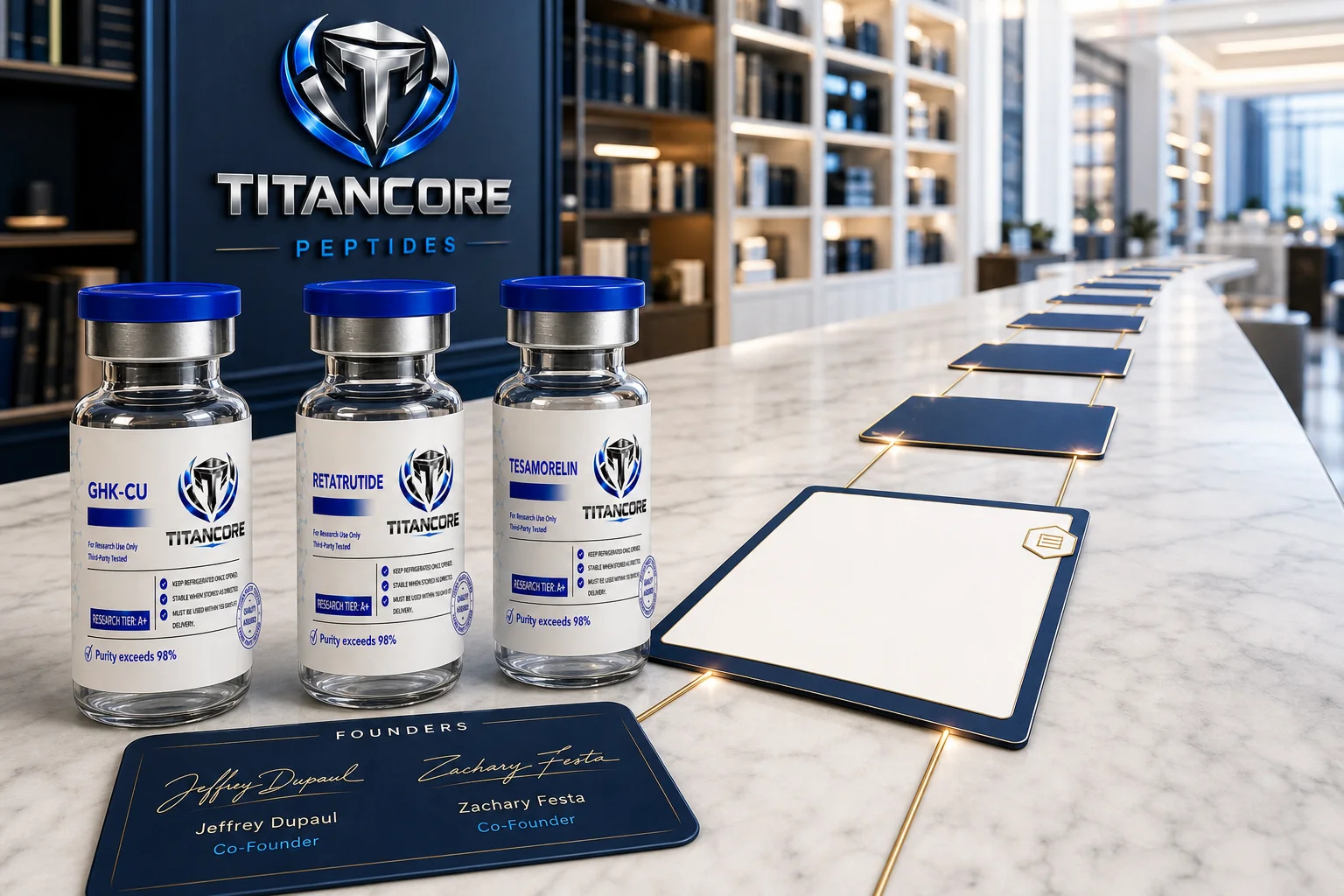
How Titan Core Is Building Trust as a New Research Peptide Supplier
Titan Core is a new peptide supplier without years of reviews behind it. Here's how we earn trust anyway: named founders, honest status labe...
No account? Create one(required before checkout)
Already registered? Login
💸 NEW MEMBER SALE! SIGN UP FOR 30% OFF - EXP. 5 DAYS AFTER SIGN UP 💸 • 💧 SPEND $49.99+ GET FREE 3ML BAC WATER + FREE 2-DAY SHIPPING! 🚚💨 • 💸 NEW MEMBER SALE! SIGN UP FOR 30% OFF - EXP. 5 DAYS AFTER SIGN UP 💸 • 🔒 CHECKOUT VIA SECURED ACH BANK TRANSFER 🔒 • 📦 SAME DAY SHIPPING MON / FRI BY 4PM EST 📦
EVERY PEPTIDE SELLER SAYS "QUALITY." ALMOST NONE OF THEM TELL YOU WHAT THEY'D HAVE TO DO TO EARN THE WORD.
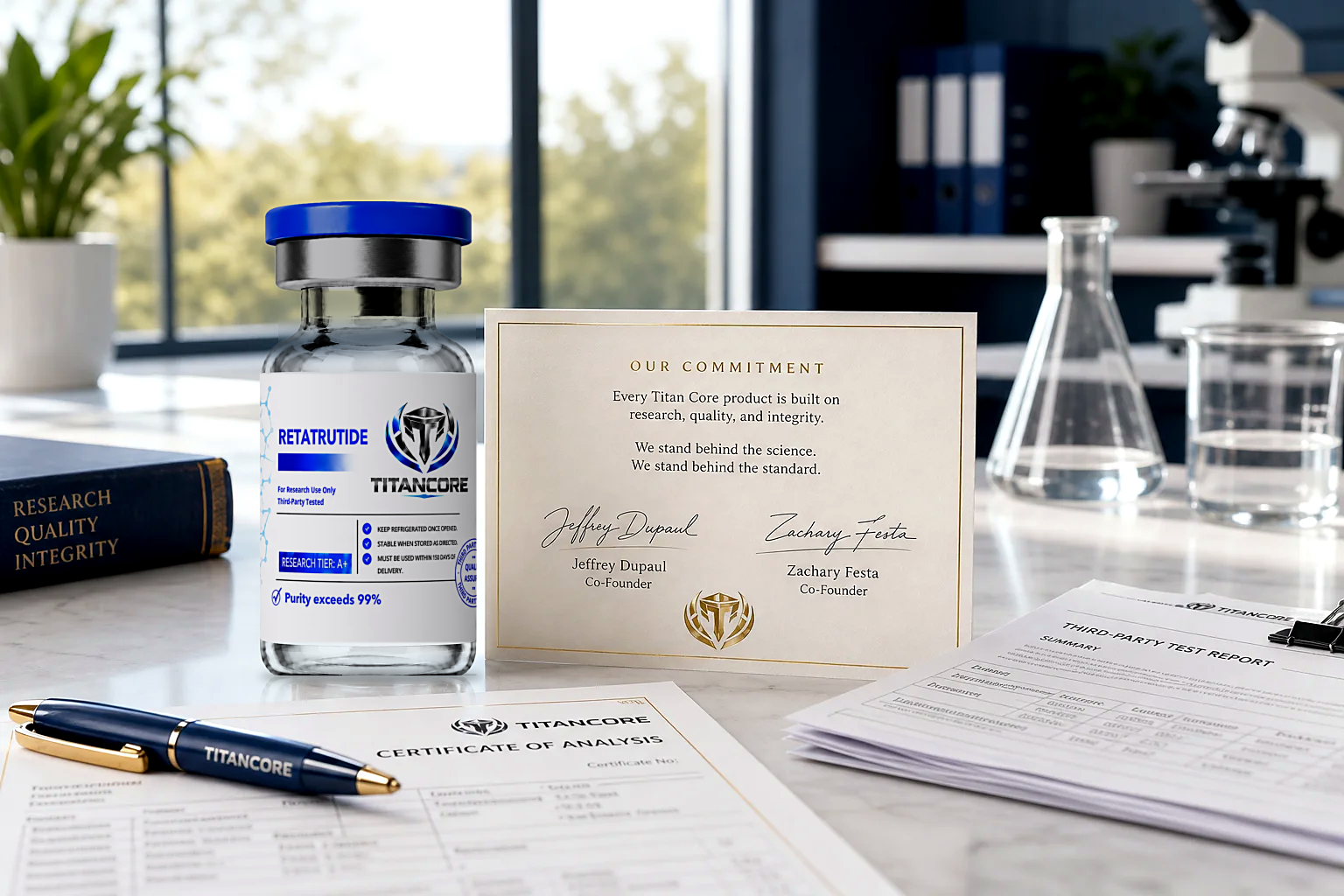
At Titan Core, three words sit next to the founders' signatures on our brand materials: Research. Quality. Integrity. Jeffrey Dupaul and Zachary Festa didn't put them there as decoration. Each one is supposed to change how a product page gets written, how a lab report gets shown to you, and how we answer when something isn't ready yet. These are our peptide quality standards in plain terms, and they're the standard you're welcome to measure us against.
This is the mistake we see most often in this market, and it's usually made on purpose.
A seller finds a real paper about a compound, quotes it on the product page, and lets you connect the dots. The paper is real. The dots aren't. Take retatrutide. Published research describes it as a single molecule that acts on three receptors at once: GIP, GLP-1 and glucagon. That tells you what retatrutide is. It tells you nothing about what's inside a vial some website is selling under that name.
Those are two different questions, and only one kind of evidence answers the second: testing tied to that specific product and batch. It's why our retatrutide peptide page leans on identity testing by mass spectrometry and purity by HPLC, with a report tied to the vial's LOT, instead of leaning on the literature to do the vouching.
Research also means staying in our lane. We'll talk about compound identity, what a study actually looked at, how to read documentation, and what to ask a supplier. We won't turn any of it into personal-use advice.
"Lab tested" is a claim. A report you can open and read is evidence. The gap between them is a handful of plain details, and a real certificate of analysis should show you all of them:
If one of those is missing, the truthful label might be "pending." We'd rather show you that word than cover the gap with a shiny badge.
There's a deeper layer too, and most sellers never bring it up. A test is only as good as the method behind it. In November 2023, the International Council for Harmonisation (ICH), whose guidelines regulators like the FDA adopt, approved an updated guideline on analytical method validation, called Q2(R2), and the FDA published it as final guidance in March 2024. It spells out what a method has to prove before its numbers deserve trust: specificity, range, accuracy, precision and robustness. In plain English, the test has to pick out the right substance, work across the amounts being measured, land close to the true value, give the same answer when repeated, and hold up to small changes in how it's run. Research suppliers aren't drug makers, and we're not claiming to follow drug rules. But that's the yardstick serious labs use, and it's a fair question to ask about any report you're handed.
Integrity is the least exciting of the three words, and the one that costs the most to keep. It mostly shows up in small calls nobody applauds.
A broken product link gets fixed before anyone's sent to it. An old document doesn't get dressed up as current. When the way we operate changes, the website changes with it. A founder's signature never gets used to suggest a product has been scientifically validated.
And a research-only line is never followed by a promise about human results. That last one matters more than people think. The FTC's health products guidance, updated in December 2022, says it outright: a disclaimer won't fix an otherwise deceptive claim. Plenty of sellers print "for research use only" and then write copy that winks the other way. The research-only disclaimer only means something if the rest of the page agrees with it.
These calls slow us down sometimes. A launch waits. A page stays unpublished for an extra day. We're fine with that.
Their signatures are a mark of ownership. They tell you the company is tied to two real people who answer for it.
They don't replace a certificate of analysis, an independent lab record or a product spec sheet. They're not legal or regulatory review, and they're not a substitute for your own due diligence or for technical review by someone qualified. That's why you'll find their names on company and mission content like this post, and you won't find them propping up a product page. Product pages have to stand on their evidence.
Before anything new goes up on titancorepeptides.com, someone checks it against all three words. Is the science described within its real scope? Is every specific claim backed by current evidence, with the right product name and image? Does every link work, and is anything pending labeled that way? Then a responsible reviewer or founder signs off. If it doesn't pass, it doesn't go up.
We won't pretend trust and sales are unrelated. We're a business, and we'd like you to order.
But here's how we see it. When you can recognize the product, see where the research-only line sits, read the evidence yourself and reach a person when something's unclear, there's a lot less standing between "maybe" and "yes." That doesn't guarantee a sale, and it shouldn't. It just means that if you do order, you did it with your eyes open. Buyers like that tend to come back, and that's the kind of business Jeffrey and Zachary want to build. Our quality standards page is a good place to see how the testing side works.
FDA: Q2(R2) Validation of Analytical Procedures, Guidance for Industry (March 2024)
Federal Trade Commission: Health Products Compliance Guidance (December 2022)
For research and laboratory context only. Brand signatures do not validate a product, document or scientific conclusion.
Research-use notice: All Titan Core products are sold strictly for laboratory research use and are not for human consumption. Published research describes compounds, not any specific Titan Core listing. Check the product page, its LOT and its current documentation before placing an order.
Titan Core is a new peptide supplier without years of reviews behind it. Here's how we earn trust anyway: named founders, honest status labe...
Strength Starts at the Core isn't a gym slogan. For Titan Core, it's a working standard: correct product identity, tests that answer the rig...
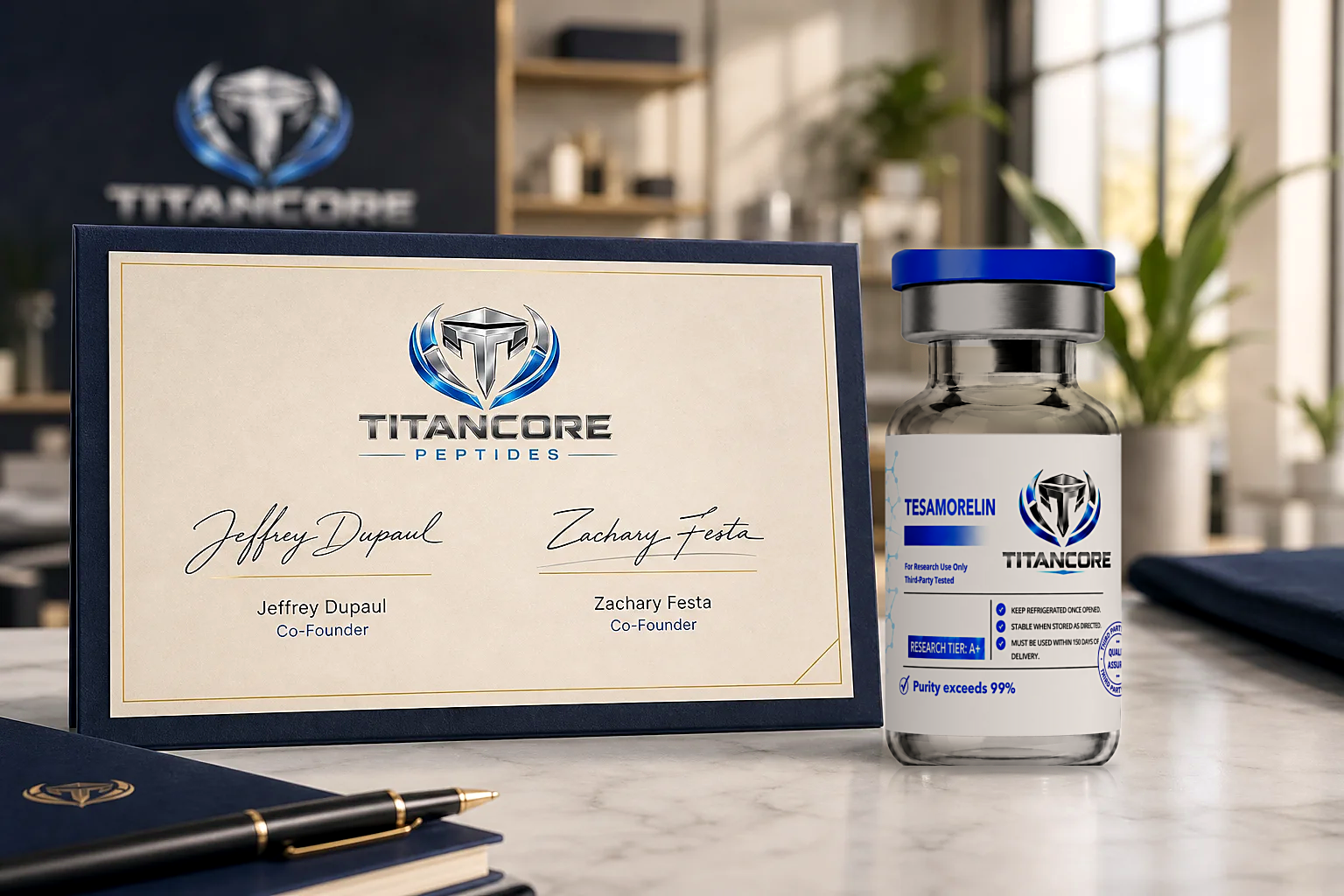
Who's actually behind Titan Core? Meet co-founders Jeffrey Dupaul and Zachary Festa, what their signatures on the brand really mean, and why...