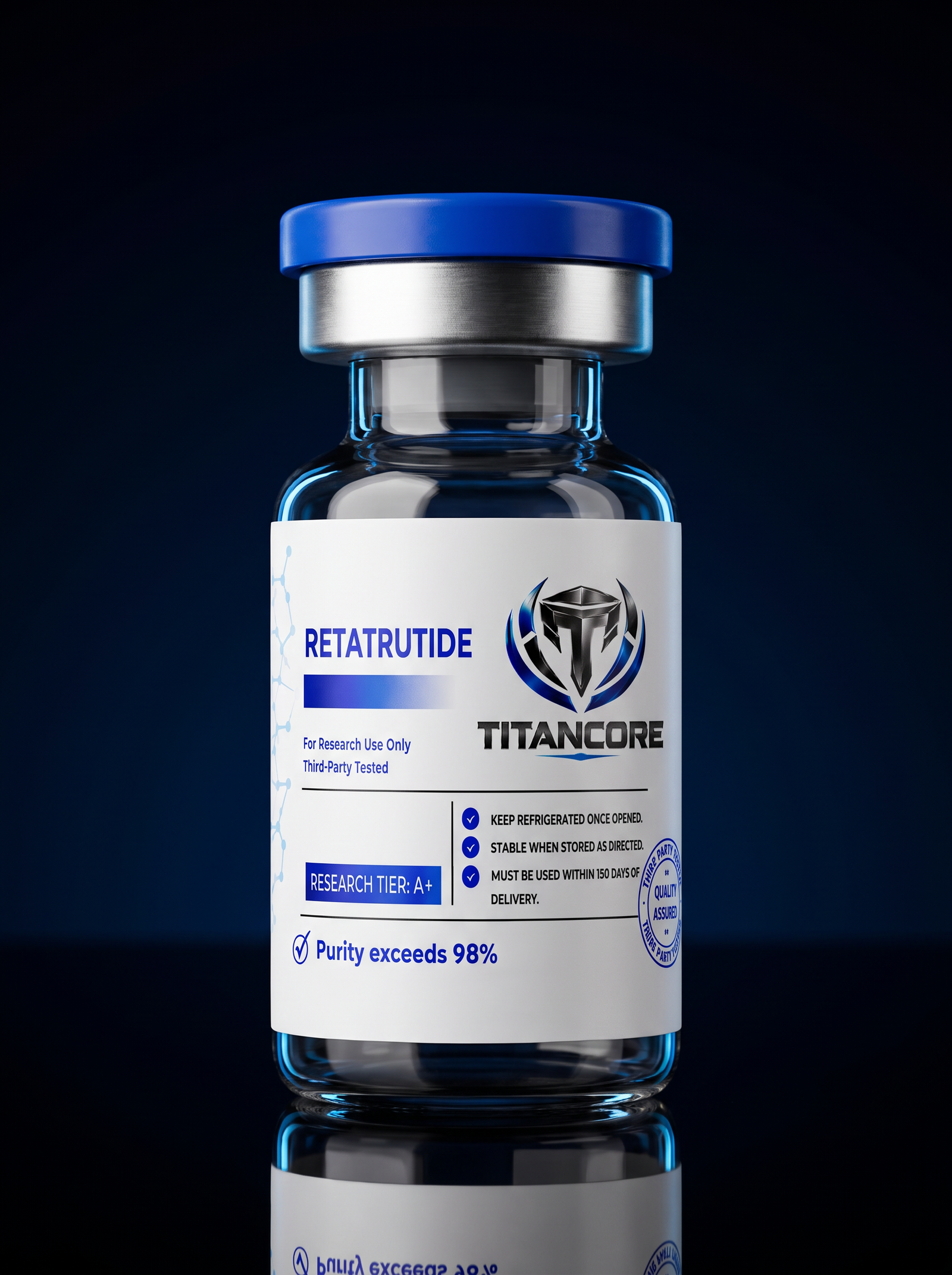
Retatrutide (LY3437943) is Eli Lilly's single molecule that activates three receptors: GIP, GLP-1 and glucagon. Hence the GLP-3 retatrutide nickname, though no hormone called GLP-3 exists. A C20 fatty-acid chain on lysine 17 lets it ride on albumin for days. Lilly's phase 3 TRIUMPH program is testing it at scale, with TRIUMPH-1 and TRIUMPH-3 reaching primary completion in April 2026.
That fame brings copies. A 2026 preprint by Mendias and Awan, covering 6,441 independent test reports, found 59 retatrutide samples that didn't contain retatrutide, the most of any compound. Australia's TGA reported in September 2026 on a vial sold as retatrutide that held semaglutide. No substitute matches retatrutide's mass with that lipid chain attached, so mass spectrometry exposes a swap at once. Titan Core makes retatrutide in the USA and tests every batch for identity and purity by mass spec and HPLC; the downloadable report carries your vial's LOT number. Some sellers list this compound under code names without naming the molecule. We publish its name, sequence and CAS. It's for laboratory research only, not for human or animal use.
Research Highlights
- Uneven triple agonism — In cell assays, retatrutide showed balanced glucagon and GLP-1 receptor activity but stronger GIP activity; in obese mice, the glucagon arm added energy expenditure (Coskun et al., Cell Metabolism, 2022).
- Once-weekly kinetics — A phase 1b study in 72 adults with type 2 diabetes found dose-proportional pharmacokinetics and a half-life near six days (Urva et al., The Lancet, 2022).
- Liver fat research — A 98-participant substudy in steatotic liver disease tracked liver fat at 24 and 48 weeks alongside insulin-sensitivity and lipid measures (Sanyal et al., Nature Medicine, 2024).
- Kidney biomarkers — In type 2 diabetes, the 12 mg arm cut urine albumin-to-creatinine ratio 37.0% versus placebo at 36 weeks, eGFR unchanged (Heerspink et al., Kidney International Reports, 2025).
- A dedicated CKD trial — TRANSCEND-CKD randomized 146 adults with obesity and kidney disease to measure GFR by iohexol clearance at week 24 (Heerspink et al., Nephrology Dialysis Transplantation, 2026).
- Glucagon arm and lipids — In human liver cells, retatrutide lowered ANGPTL3/8 secretion, and a glucagon-receptor antibody blocked the effect (Wen et al., Diabetes, Obesity and Metabolism, 2025).
- Cardiovascular biomarkers — Phase 2 analyses recorded apolipoprotein B falls of 21.4% and 24.2% in two studies (Ruotolo et al., Diabetes, Obesity and Metabolism, 2026).