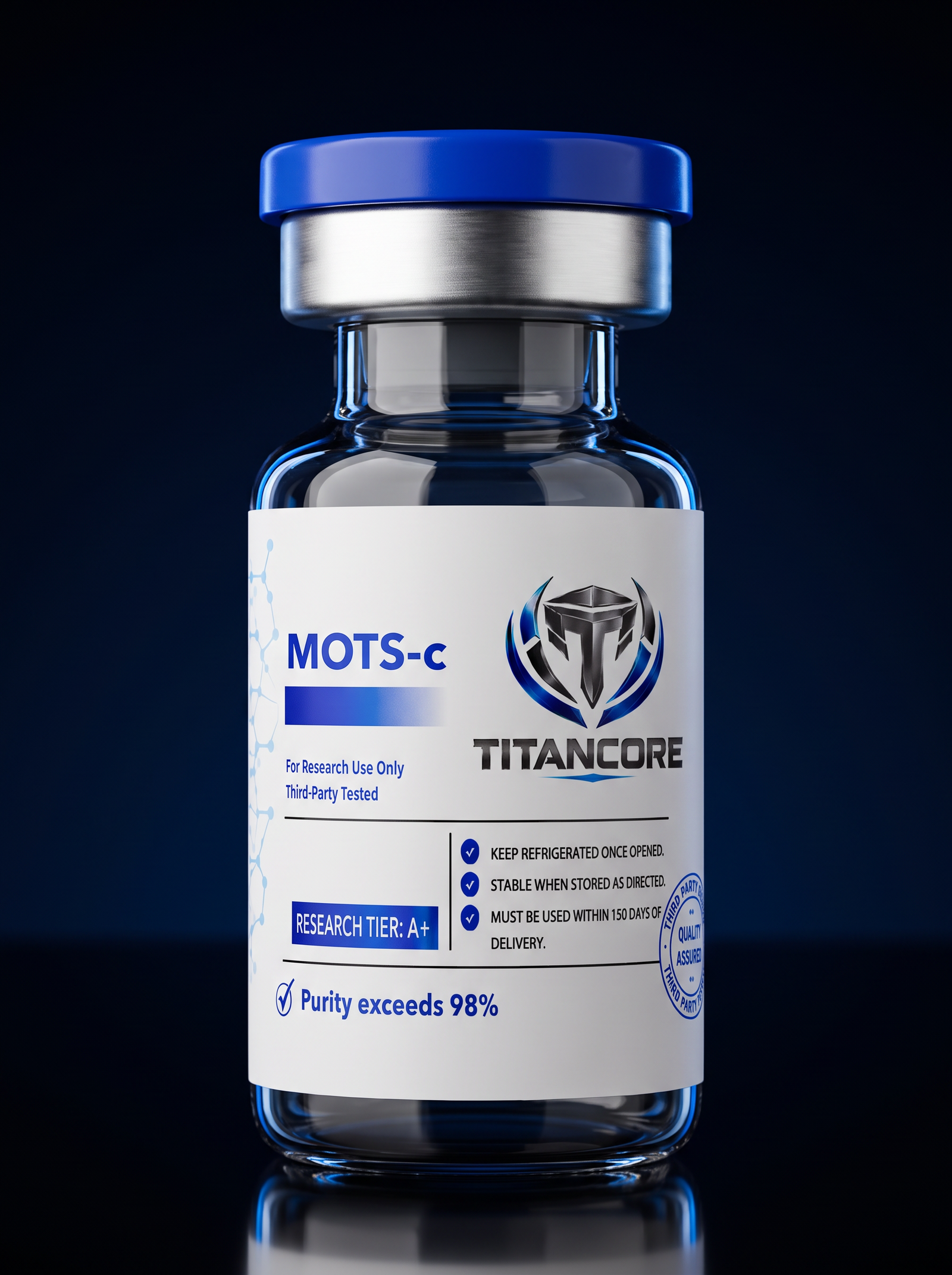
MOTS-c is one of the few peptides coded by mitochondrial DNA rather than the nucleus. Its 16 residues are read from a short open reading frame inside the MT-RNR1 gene, the stretch that also encodes the mitochondria's 12S ribosomal RNA. That origin is why MOTS-c peptides sit at the center of research on how mitochondria signal to the rest of the cell, from muscle metabolism to stress responses in the lung and liver.
Here's why the sequence matters so much. In 2024, iScience reported that MOTS-c works through the kinase CK2, and that K14Q MOTS-c, a naturally occurring variant with glutamine in place of lysine at position 14, binds CK2 poorly and fails to activate it or produce its effects. A vial is only as useful as its sequence is exact. Titan Core publishes the full sequence below, and every batch goes to an independent lab for HPLC purity and mass spectrometry, which catches missing, extra or swapped residues that shift the chain's weight. It's made in the USA, and the report you can download here carries the same LOT number as your vial. MOTS-c is sold for laboratory research only and isn't for human or animal use.
Research Highlights
- Muscle mitochondrial efficiency — In two transgenic mouse strains, MOTS-c improved muscle mitochondrial bioenergetics through PGC-1α and AMPK and lowered mitochondrial ROS emission (Free Radical Biology and Medicine, 2026).
- Membrane repair — MOTS-c bound the repair protein TRIM72 at its C-terminus, sped its trafficking to damaged membranes and interacted with PtdIns(4,5)P2 (Theranostics, 2024).
- Lung ischemia-reperfusion — In rat models, MOTS-c moved into endothelial nuclei through MYH9, phosphorylated at Ser1943 by CK2α, to switch on antioxidant genes (Redox Biology, 2025).
- Immobilization atrophy — In cast-immobilized mice, muscle mass fell 15% in controls but only 5% with MOTS-c, alongside normalized AKT and FOXO signaling (American Journal of Physiology–Endocrinology and Metabolism, 2024).
- Viral liver research — Researchers measured MOTS-c in 85 healthy people and 404 patients with hepatitis B, then tested its mitochondrial effects in infected mice and cells (Gut, 2024).
- An engineered analog — Swapping arginine 13 for alanine made R13A-MOTS-c more hydrophobic (index −0.938 to −0.544) and let it enter cells through the LAT1 transporter (Redox Biology, 2026).