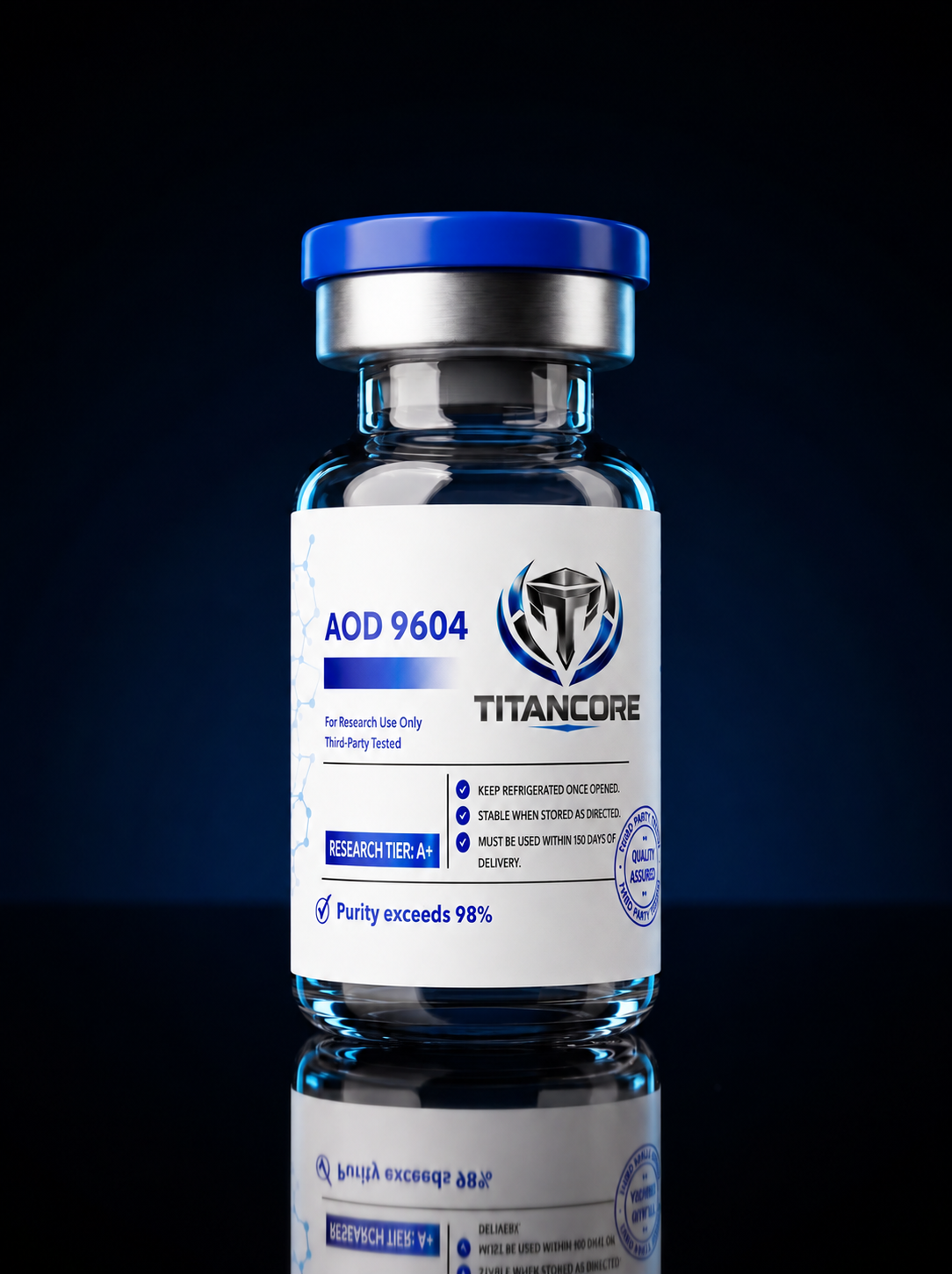
The AOD 9604 peptide is growth hormone's last 15 residues with a tyrosine added at the front, and its two cysteines lock the chain into a ring. It began as an anti-obesity candidate; labs now study what it does away from the growth hormone receptor. A 2026 Pain paper, testing it as LAT8881, identified its binding partner, LanCL1, with a probe built from its own ring-containing metabolite.
If the Cys7–Cys14 bridge never closes, the chain weighs 1,817.1 Da instead of 1,815.1, and a 2026 Frontiers in Endocrinology review notes AOD 9604 is often labelled "hGH 176-191", a different peptide 16 Da lighter. Purity can't catch either mistake, and two competitor reports we read don't try: one calls identity "confirmed" with no mass, the other runs no mass test. This page lists the sequence, bridge and bridged weight, and each vial's manufacturer LOT matches its lab report. If your LOT's report isn't posted yet, ask Contact Support before opening. Laboratory research only; not for people or animals.
Research Highlights
- Neuropathic pain models — As LAT8881, it reduced mechanical allodynia in four rodent neuropathy models, from nerve ligation to chemotherapy-induced (Pain, 2026).
- Clinical-stage pain research — A Phase II postherpetic neuralgia trial of LAT8881 found no treatment difference on its 4-week pain score (International Journal of Molecular Sciences, 2023).
- Influenza infection models — Given intranasally from day 1, LAT8881 and its metabolite lowered viral loads in influenza-infected mice, while a third peptide did not (Clinical & Translational Immunology, 2023).
- Shorter fragments — LAT9997, a 6-residue linear piece of the same sequence, also improved survival in influenza-infected mice (Journal of Infectious Diseases, 2024).
- Anti-doping detection — Dried-blood-spot screening tracks AOD9604 as a doubly charged ion at m/z 907.94, plus its residue 7–16 metabolite (Analytical and Bioanalytical Chemistry, 2020).
- Sample stability — In blood samples, AOD9604 held for two months at −20 °C but degraded within a week at 4 and 22 °C (Analyst, 2026).