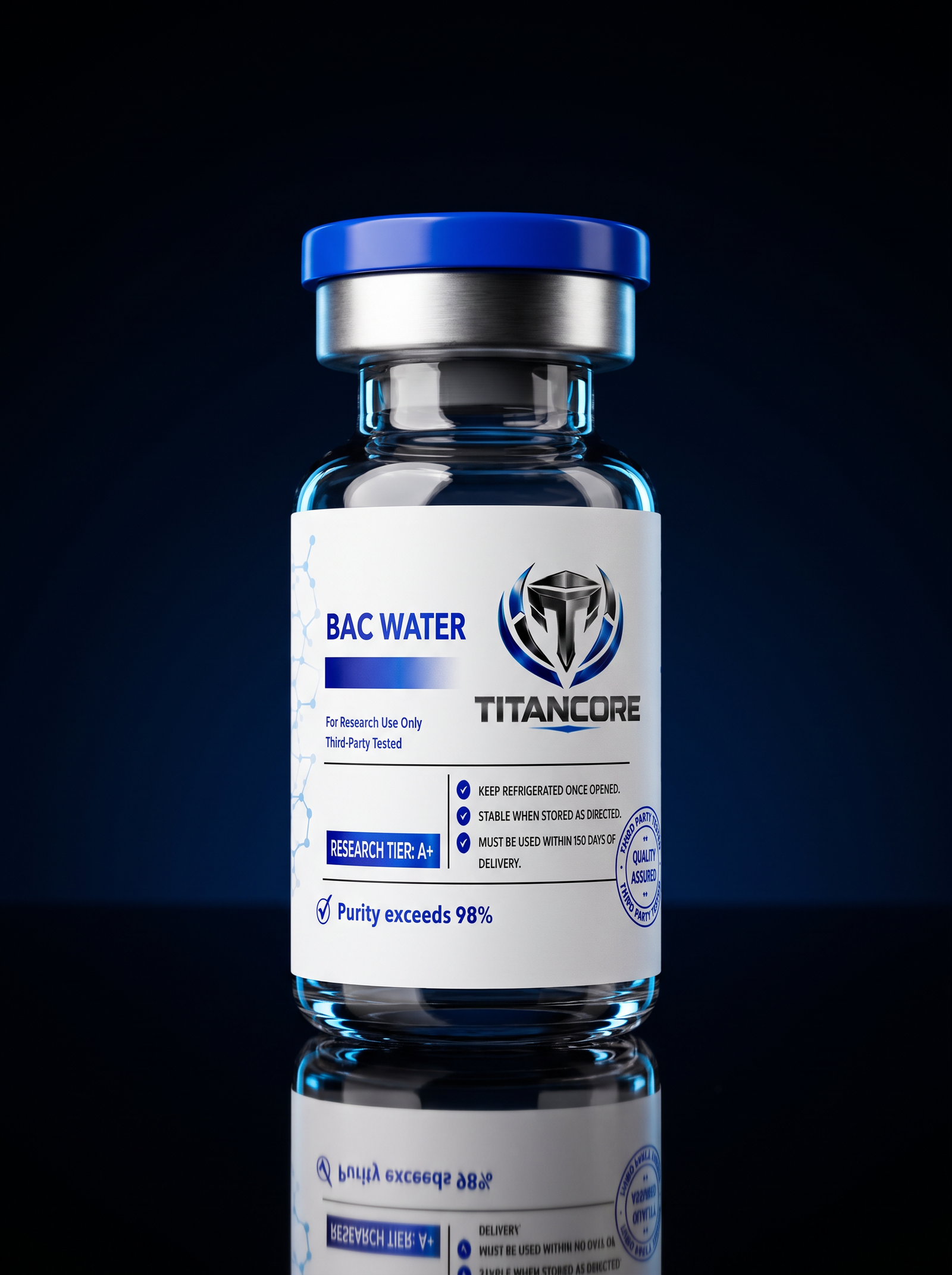
Bacteriostatic Water is sterile water with benzyl alcohol added, so a sealed vial can be drawn from again and again without bacteria taking hold. A 2023 Boehringer Ingelheim review in Pharmaceutics explains why multi-dose peptide and protein formulations need that preservative, and the catch: some preservatives raise particle formation, so the choice has to suit the molecule. The diluent is part of the experiment.
Two things go wrong with BAC water sold online: forum threads describe bottles with no preservative at all, and published reports often skip the tests that define the product. One competitor's report we read lists benzyl alcohol identity, a "purity" figure and pH, but no sterility or endotoxin result. Titan Core puts the composition on the page, prints the manufacturer LOT on each vial, and posts the lab report for that LOT here. If yours isn't up yet, ask Contact Support before you break the seal. Laboratory reagent only; not for human or animal use.
Research Highlights
- Peptide aggregation screens — With an acylated 31-residue peptide, benzyl alcohol caused no aggregation, while 1% m-cresol pulled 25% of it into insoluble aggregates within 24 hours (Molecular Pharmaceutics, 2022).
- Antibody storage testing — With the NIST reference antibody, 1.1% benzyl alcohol didn't raise subvisible particles over four weeks at 40 °C, where phenol and m-cresol did (International Journal of Pharmaceutics, 2023).
- Agitation stress — In trastuzumab shaken for five days, 1.0% benzyl alcohol drove a 21-fold jump in nano- to micro-sized particles (European Journal of Pharmaceutics and Biopharmaceutics, 2025).
- Freeze-thaw studies — Benzyl alcohol worsened freeze-thaw aggregation of trastuzumab, and 1.1% balanced preservation and damage better than 2% (International Journal of Pharmaceutics, 2026).
- Multi-dose vaccine formulation — Of seven preservatives tested with a quadrivalent HPV vaccine for up to two years at 2–8 °C, benzyl alcohol was among the best (Journal of Pharmaceutical Sciences, 2023).
- pH measurement methods — Amgen showed bacteriostatic water, allowed a USP range of pH 4.5 to 7.0, has no buffering capacity and gives noisy readings even with added KCl (Journal of Pharmaceutical Sciences, 2023).