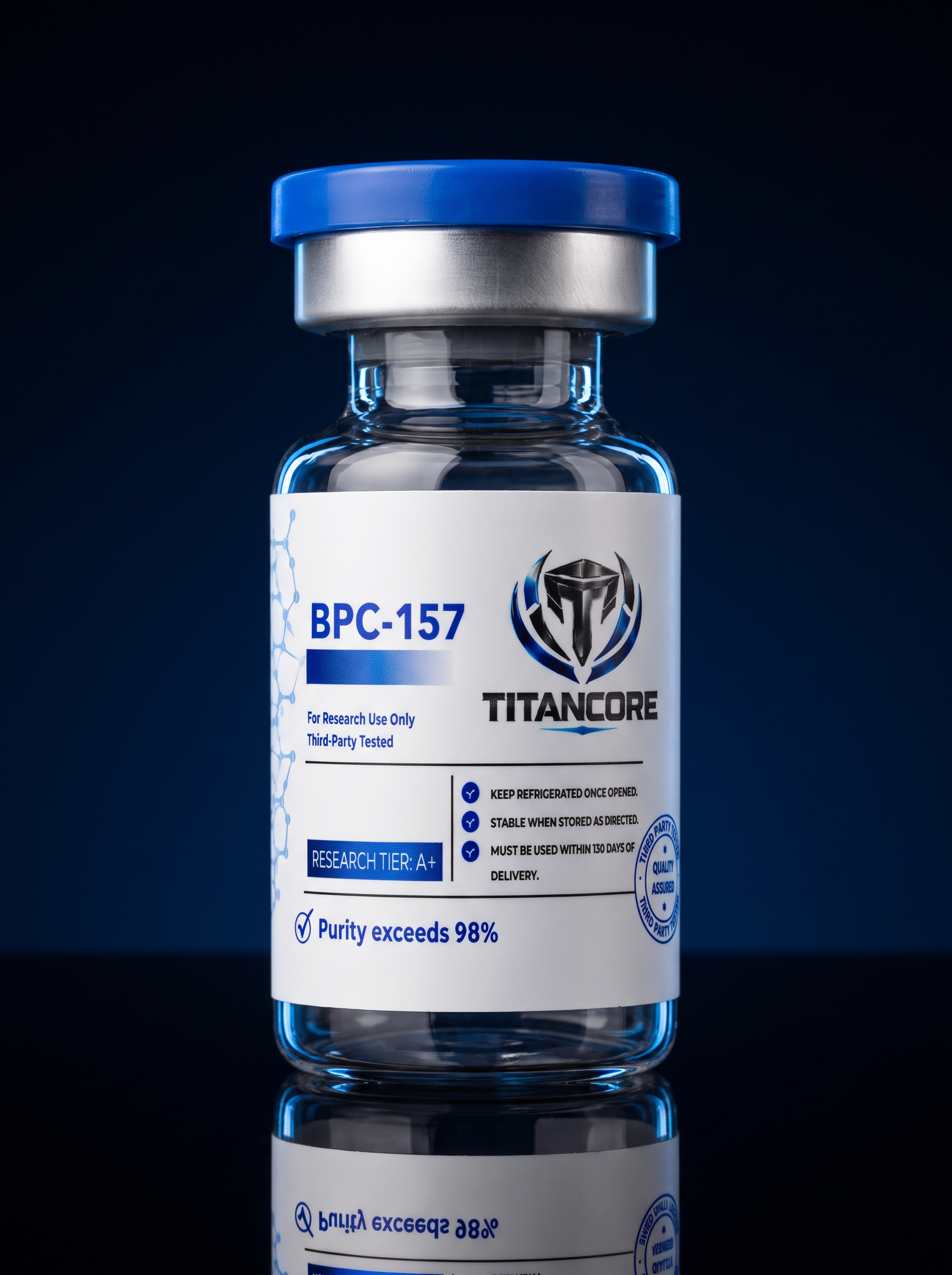
The BPC-157 peptide is a synthetic 15-amino-acid fragment of a protein found in gastric juice, and labs use it to study repair signaling in tendon, gut and blood-vessel models. Its mechanism is getting sharper: a 2026 study in Cell Communication and Signaling found BPC-157 binds the adaptor protein FBXO22 through the proline at position 3, stabilizing the transcription factor BACH1 and boosting endothelial tube formation.
That precision is why impurities matter. At its July 2026 advisory meeting, the FDA described BPC-157 acetate as not well characterized, citing missing data on impurities, aggregates, bioburden and endotoxin. A chain missing one of its four prolines weighs 97 Da less and can sit under a vague purity claim. The competitor reports we read list purity, endotoxin and milligrams, but none gives an aggregate result and one runs no mass test. Titan Core's BPC-157 is third-party tested to 99%+ HPLC purity, its sequence and 1,419.6 Da weight are listed below, and each vial's LOT ties to its lab report; if yours isn't posted yet, ask Contact Support before opening. Research reagent only; never for human or animal use.
Research Highlights
- Pharmacokinetics — In rats and beagle dogs, intact BPC-157 had an elimination half-life under 30 minutes, with intramuscular bioavailability of about 14–19% in rats and 45–51% in dogs (Frontiers in Pharmacology, 2022).
- Serum versus plasma stability — In anti-doping stability tests, BPC-157 degraded completely within a week in serum at 4 and 22 °C, but not in plasma (Analyst, 2026).
- Enzyme inhibition — BPC-157 acted as a weak competitive inhibitor of acetylcholinesterase (Ki 0.48 mM, IC50 2.80 mM), and two hybrid analogs built from it bound more tightly (International Journal of Molecular Sciences, 2026).
- Hydrogel delivery — A chitosan hydrogel encapsulated 98.9% of its BPC-157 and released 81.2% within 24 hours (3 Biotech, 2026).
- Recombinant production — Optimizing a Bacillus licheniformis expression system raised reporter signals about threefold for BPC-157 fusion proteins (Applied Biochemistry and Biotechnology, 2026).
- First intravenous safety pilot — An IRB-approved pilot gave intravenous BPC-157 to just 2 adults and tracked blood work and vital signs over 3 days (Alternative Therapies in Health and Medicine, 2025).