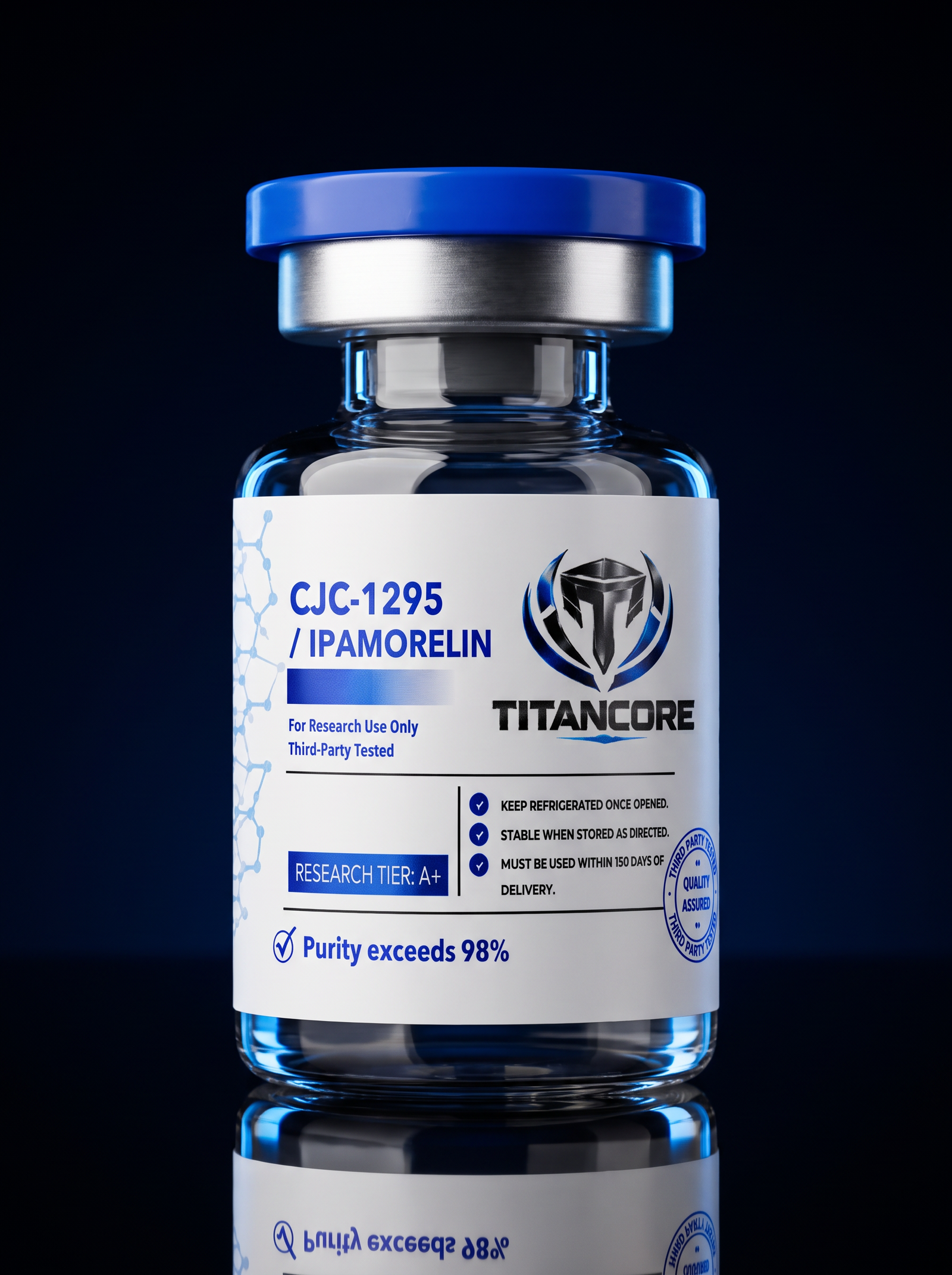
This vial pairs two separate inputs to the growth hormone axis: CJC-1295 no DAC, also called Modified GRF 1-29, a stabilized copy of GHRH's first 29 residues, and ipamorelin, a five-residue ghrelin-receptor agonist. A 2026 Frontiers in Endocrinology review of GH-axis peptides places ipamorelin with the ghrelin-receptor secretagogues rather than the GHRH analogs, and that split is why labs combine the two: each signal can be studied on its own or together.
The name is the trap. "CJC-1295" is also sold as the DAC version, 3,647.2 Da, carrying a maleimido group that locks onto albumin; the no-DAC form here weighs 3,367.9. It gets stranger: in 2019, Danish customs samples run by high-resolution mass spectrometry turned out to be ipamorelin and Modified GRF 1-29 with an extra glycine attached, a 57 Da change a purity figure won't show. Titan Core lists both sequences, formulas and weights below and ties each vial's LOT to its lab report; if yours isn't posted yet, ask Contact Support before opening. Made for bench work, and not for use in people or animals.
Research Highlights
- Gut motility models — In isolated ferret ileum, ipamorelin cut electrically stimulated contractions by 54.4%, with an IC50 of 11.7 µM (Physiology & Behavior, 2024).
- Visceral pain models — In rats sensitized with 0.6% acetic acid, peripherally restricted ipamorelin reduced colonic hypersensitivity, and a ghrelin-receptor antagonist blocked the effect (Journal of Experimental Pharmacology, 2020).
- Fish reproductive axis — Over 21 days, ipamorelin acetate raised food intake and spermatocyte counts in tilapia (Animal Reproduction Science, 2024).
- Antibody-based detection — An immuno-PCR assay detected albumin-bound CJC-1295 down to 0.8 pg, since the conjugate escapes top-down mass spectrometry (Drug Testing and Analysis, 2019).
- Equine plasma testing — An LC-MS/MS method confirmed CJC-1295 in 1 mL of horse plasma at concentrations as low as 180 pg/mL (Drug Testing and Analysis, 2019).
- Urine screening — A nano-LC Orbitrap method detected CJC-1295, sermorelin and tesamorelin in urine at 0.5 ng/mL or lower (Journal of Pharmaceutical and Biomedical Analysis, 2026).