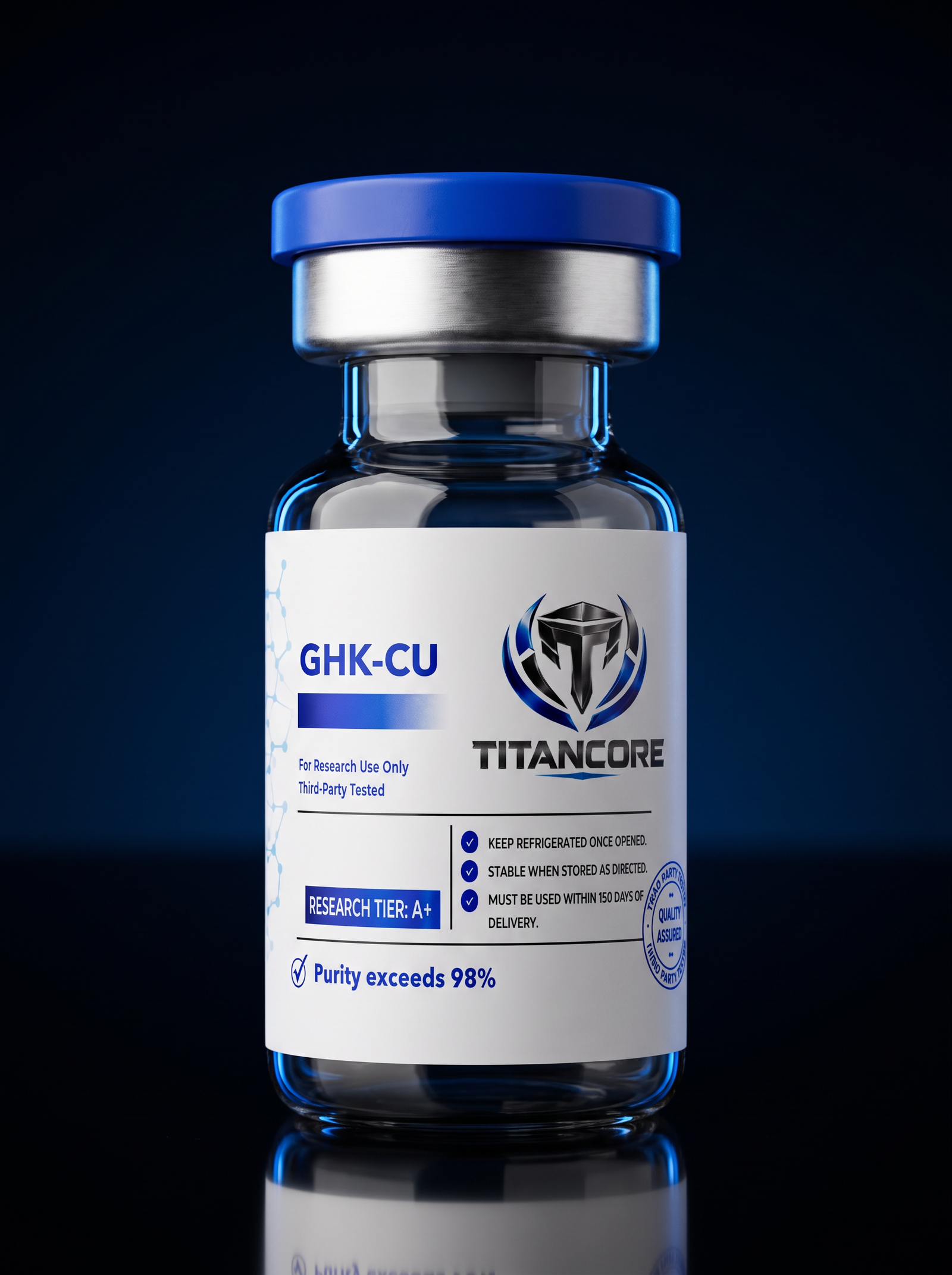
GHK-Cu is glycine-histidine-lysine, a tripeptide found in human plasma, holding a single copper(II) ion. The copper sits locked between the histidine ring, glycine's amino group and a peptide-bond nitrogen, and that grip is what makes this ghk cu copper peptide more than a small amino-acid chain. A 2026 systematic review in Pharmaceutics found that preclinical work consistently links it to matrix remodeling, epithelial repair, inflammation and redox control, and new blood vessel formation.
The same review named the problem most suppliers skip. Total peptide and copper are usually reported, while molar copper occupancy, meaning how much of the GHK actually carries copper, and free copper are usually not measured. Two published third-party reports on copper-peptide blends from other sellers show why that matters: the GHK and copper weights they list work out to roughly 0.7 copper per peptide, not one. Some listings even print plain GHK's molecular weight for GHK-Cu. Titan Core makes GHK-Cu in the USA as the finished copper complex, not as peptide mixed with copper salt, and an independent lab checks every batch by HPLC for purity and mass spectrometry for identity. The report is downloadable here under the same LOT as your vial. It's sold for laboratory research only, not as a cosmetic and not for human or animal use.
Research Highlights
- Silicosis lung model — In silica-exposed mice, GHK-Cu bound peroxiredoxin 6 in alveolar macrophages, easing oxidative stress along with lung inflammation and fibrosis (Redox Biology, 2024).
- Smoke-induced emphysema — After 12 weeks of cigarette smoke in mice, GHK-Cu partly corrected the MMP-9/TIMP-1 imbalance, lowered IL-1β and TNF-α, and raised Nrf2 (Frontiers in Molecular Biosciences, 2022).
- Fibrosis signaling — In bleomycin-induced lung fibrosis, GHK-Cu reduced collagen deposition and acted through TGFβ1/Smad2/3, Nrf2 and NF-κB pathways (Life Sciences, 2020).
- Acute inflammation in zebrafish — GHK-Cu cut neutrophil and macrophage migration, lowered tnf-a, il-1β and il6, raised il-10, and downregulated JAK1 signaling (European Journal of Pharmacology, 2026).
- Mitochondrial function — In C. elegans, GHK-Cu raised mitochondrial membrane potential, shifted dynamics toward fusion via drp-1 and fzo-1, and activated DAF-16 and SKN-1 (Biogerontology, 2026).
- Elastin production — Copper tripeptide-1 increased elastin expression and secretion in dermal fibroblasts, tested alongside UV-damaged human skin samples (Current Issues in Molecular Biology, 2026).