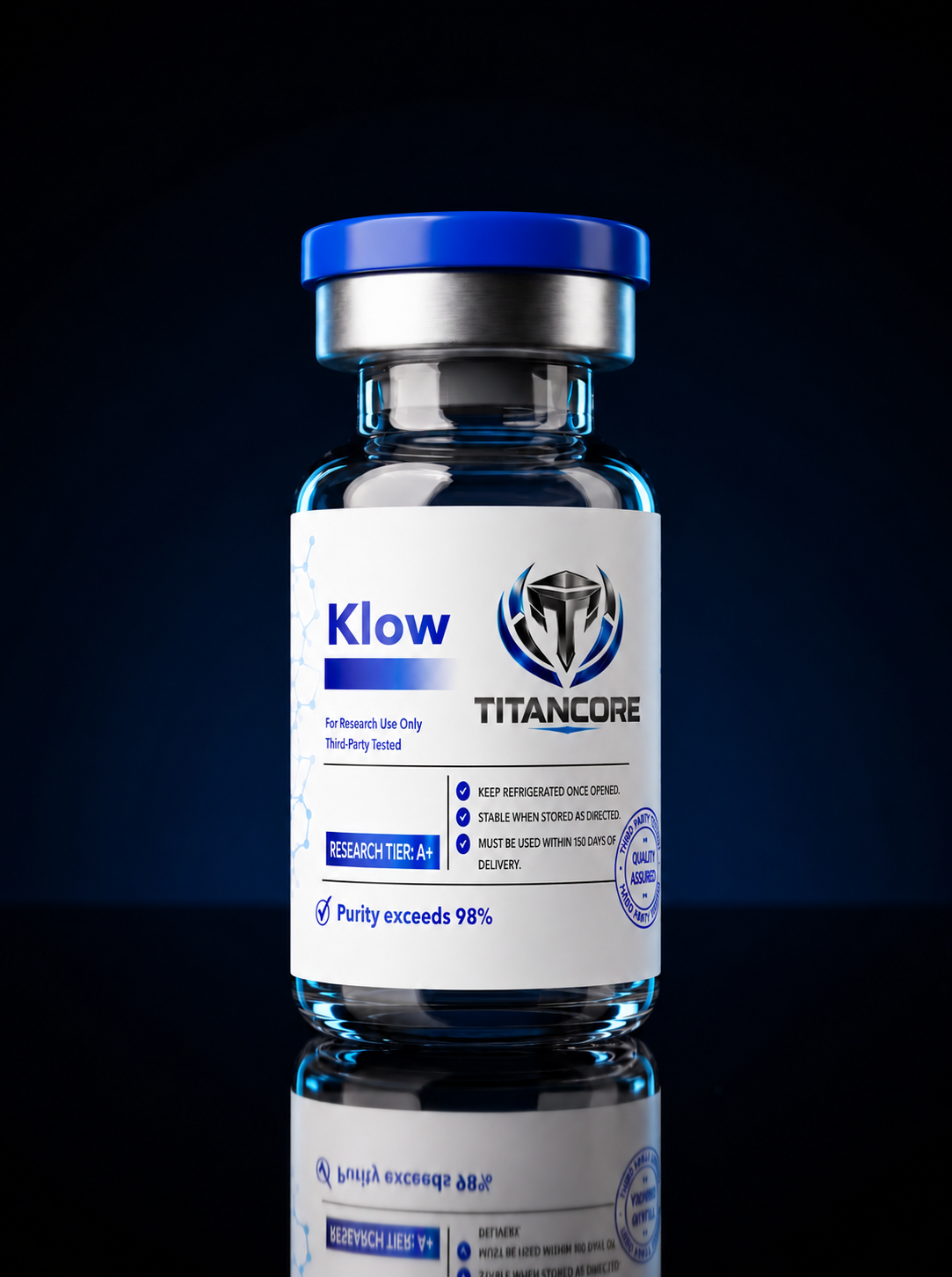
The KLOW peptide starts from GLOW's three: GHK-Cu, BPC-157 and TB-500. The fourth, KPV, is Lys-Pro-Val, and a 2023 review in Cells traces α-MSH's anti-inflammatory action to those three residues, tested in DSS and T-cell-transfer colitis models in mice. One vial, a repair side and an inflammation side.
The weak spot is KPV itself. It's the smallest peptide here, so a short fill barely moves a whole-blend purity figure, and one competitor KLOW report we read gives only that: one HPLC number for four peptides. "KPV" is also more than one molecule. The free acid weighs 342.4 Da and the amide 341.4, and none of the three competitor reports we read says which form they contain. Titan Core names it: KPV free acid, C₁₆H₃₀N₄O₄, CAS 67727-97-3, with every peptide's amount listed below, so the lab report for your LOT can be read peptide by peptide; if it isn't posted yet, ask Contact Support before opening. Bench research only; not for people or animals.
Research Highlights
- Oral delivery to inflamed tissue — A ROS-triggered KPV conjugate reached 3.8-fold higher colonic levels than free KPV in colitis mice and worked at a 20-fold lower dose (Science Advances, 2026).
- Keratinocyte stress models — In human HaCaT keratinocytes exposed to PM10 fine dust, 50 µg/mL KPV restored viability, cut IL-1β and curbed ROS-driven ERK and p38 activation (Tissue and Cell, 2025).
- Colitis nanoparticle studies — In mice given 2.5% or 4% DSS, KPV co-assembled with FK506 restored tight-junction proteins beyond either compound alone (Frontiers in Pharmacology, 2024).
- Oral mucositis hydrogels — In a mucoadhesive hydrogel that gels at 36.2 °C within 100 seconds, KPV kept its anti-inflammatory and cell-migration activity (Biomaterials Science, 2021).
- Adipocyte differentiation — In 3T3-L1 preadipocytes, 100 µg/mL KPV cut Oil Red O staining by about 55% and triglyceride content by about 38% (Tissue and Cell, 2026).
- Colon barrier hydrogels — A KPV-binding double-network hydrogel with a 17.6 Pa storage modulus kept KPV active longer and improved barrier recovery in TNBS-colitis rats (Acta Biomaterialia, 2022).