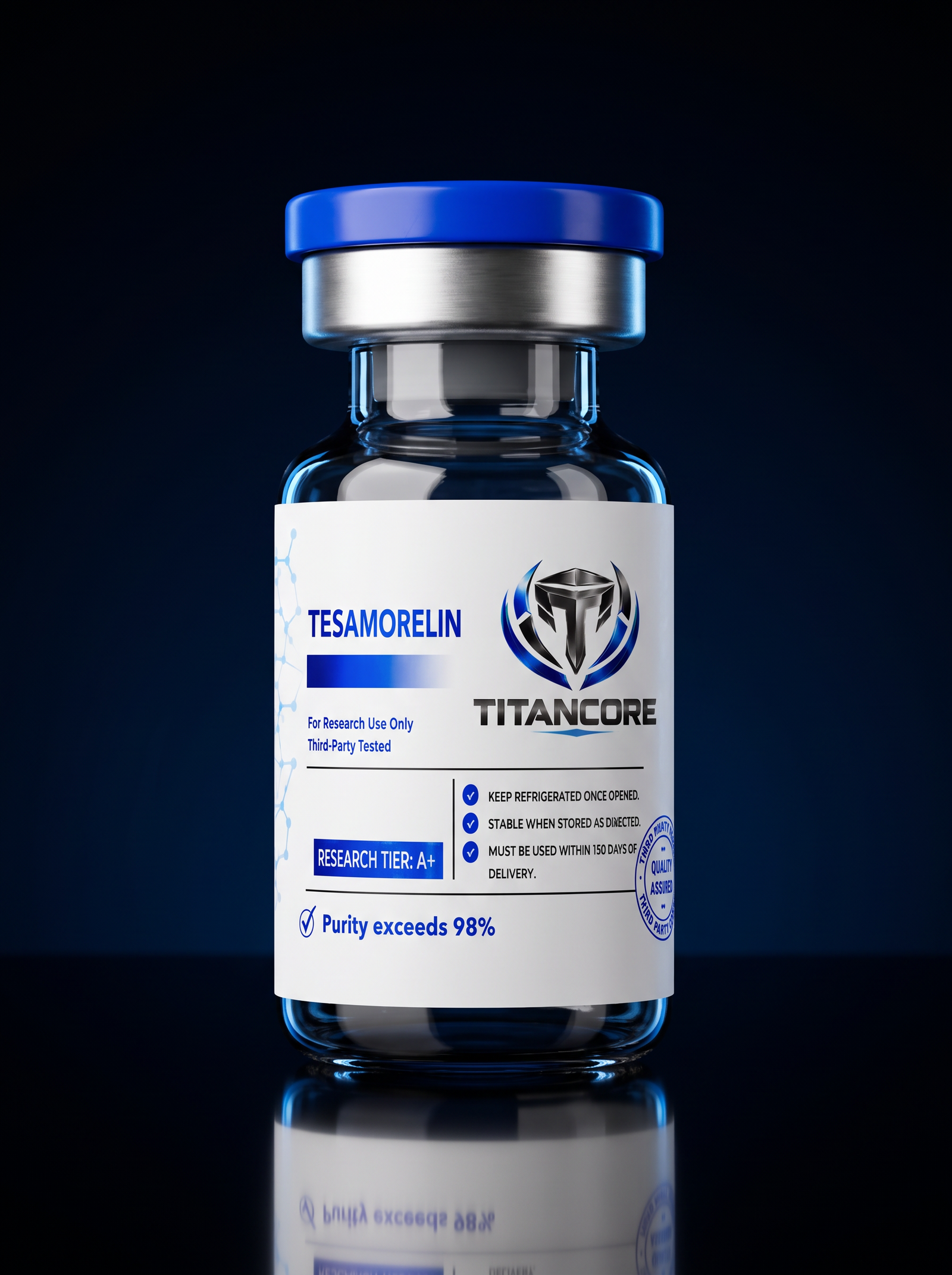
Tesamorelin is a synthetic analog of growth hormone-releasing hormone that keeps all 44 amino acids of the human sequence and adds a trans-3-hexenoic acid group at the N-terminus, the cap that slows enzymatic breakdown. It stimulates the pituitary's own growth hormone release rather than replacing the hormone. It's also the rare research peptide with a regulatory record: the FDA approved it in 2010, as Egrifta, for HIV-associated lipodystrophy, so labs studying tesamorelin peptides have more human data to work from than most GHRH analogs.
That same demand drives copies. A 2026 preprint by Mendias and Awan, covering 6,441 independent test reports, found 11 tesamorelin samples that didn't contain tesamorelin at all. The subtler failure is the missing cap: the hexenoyl group adds under 100 Da to a chain of more than 5,000, so an uncapped GHRH can sit right beside the real product on a chromatogram. Mass spectrometry separates them cleanly. Titan Core's tesamorelin is made in the USA, and an independent lab checks every batch by HPLC for purity and mass spectrometry for the complete molecule, hexenoyl cap included. The report you download here carries the same LOT number as your vial. It's supplied strictly for lab research, never for use in people or animals.
Research Highlights
- Liver fat in HIV — In 61 people with HIV and fatty liver, tesamorelin cut hepatic fat fraction 37% relative to baseline over 12 months, and 35% versus 4% reached under 5% liver fat (Lancet HIV, 2019).
- Hepatic gene signatures — Paired biopsies from that trial showed tesamorelin raised oxidative-phosphorylation gene sets and lowered sets tied to inflammation and cell division (JCI Insight, 2020).
- Immune activation markers — Across 92 plasma biomarkers, tesamorelin lowered 13, including CCL3, CCL4 and CD8A, and raised none (Clinical Infectious Diseases, 2021).
- Fat quality, not just quantity — In 341 participants, visceral fat density rose 6.2 HU with tesamorelin versus 0.3 HU with placebo over 26 weeks (AIDS, 2021).
- Neurocognition — A 73-person phase 2 trial saw IGF-1 rise, but no significant between-group difference in neurocognitive performance at six months (Journal of Infectious Diseases, 2025).
- Detection science — Researchers identified 19 in vitro metabolites across four GHRH analogs, including tesamorelin, to build urine detection methods (Drug Testing and Analysis, 2021).