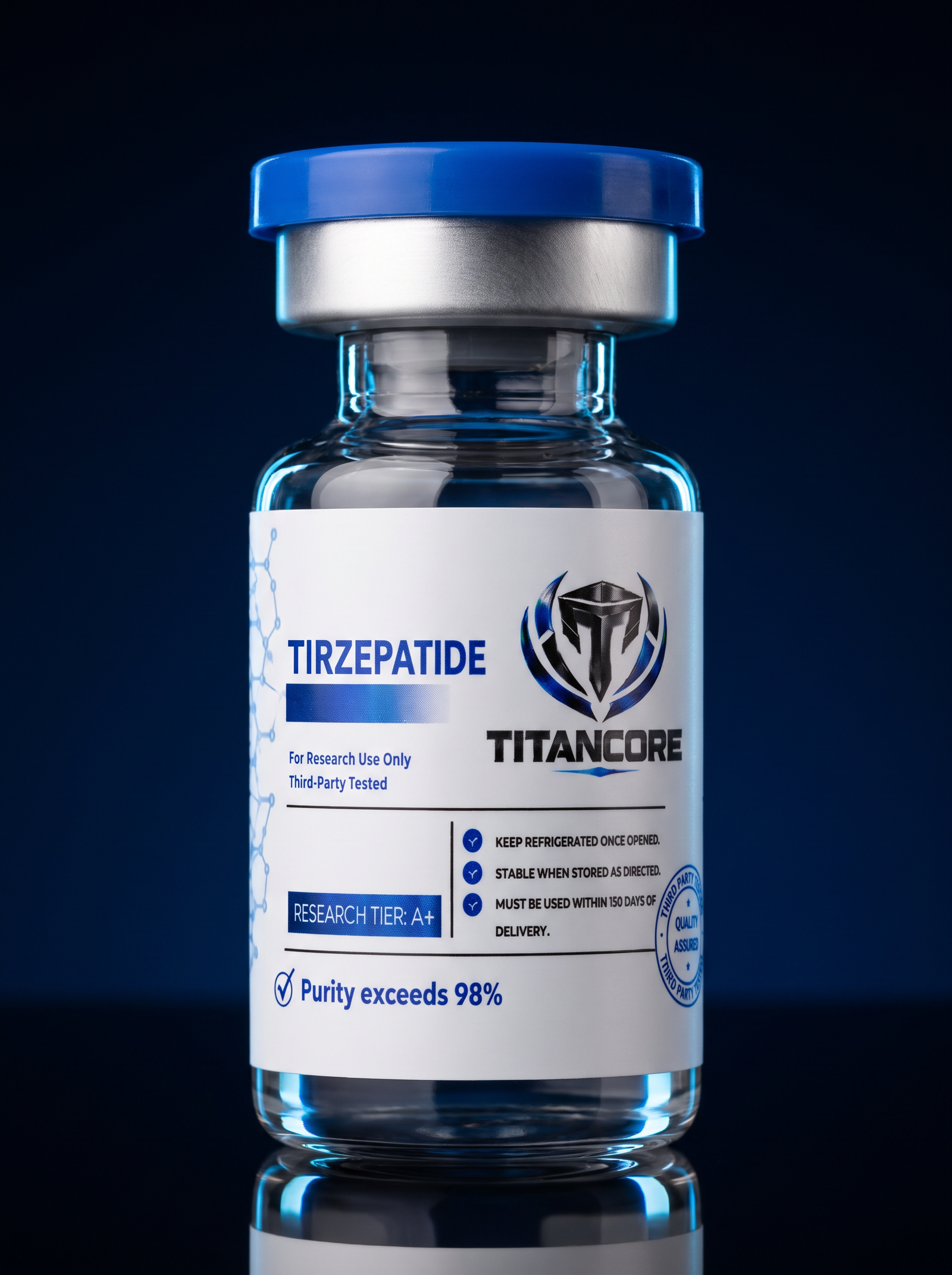
Tirzepatide is a 39-residue peptide built on the GIP hormone backbone and tuned to reach the GLP-1 receptor as well, with a C20 fatty diacid chain on lysine 20 that lets it ride on albumin. Labs use it to pull the two receptors' jobs apart: in a 2021 Journal of Clinical Investigation study, tirzepatide still improved insulin sensitivity in obese mice lacking the GLP-1 receptor, pointing to GIP receptor action in white fat.
The worry is whether a vial holds only tirzepatide. A 2026 Annals of Pharmacotherapy survey of 33 unusual compounded semaglutide and tirzepatide products found 48% mixed the peptide with extras such as cyanocobalamin, glycine or ondansetron. The lipid chain is the other weak point: without it, the backbone weighs about 4,070 Da instead of 4,813.5, and a purity percentage won't flag that. One competitor sells its tirzepatide in four strengths but posts reports for only two. Titan Core's vial holds tirzepatide alone, its lipidated weight is listed below, and each manufacturer LOT ties to a lab report; if yours isn't posted yet, ask Contact Support first. Lab research only; it isn't a stand-in for the branded drugs.
Research Highlights
- Receptor bias studies — It matched native GIP at the GIP receptor but, at the GLP-1 receptor, bound 5-fold weaker and signalled cAMP 20-fold less potently than GLP-1, with under 10% arrestin recruitment (JCI Insight, 2020).
- Metabolism tracing — Carbon-14 tracing in humans, rats and monkeys found about 66% of radioactivity in urine, no intact peptide in excreta, and beta-oxidation of the C20 diacid (European Journal of Pharmaceutical Sciences, 2024).
- Heart failure models — Over 14 days in angiotensin II-infused mice, tirzepatide reduced mortality and preserved cardiac function, compared with liraglutide (Cardiovascular Diabetology, 2025).
- Blood pressure research — In stroke-prone spontaneously hypertensive rats, tirzepatide raised mean blood pressure to 197.4 mmHg against 153.7 in pair-fed controls at day 28, with signs of sympathetic activation (Hypertension Research, 2026).
- Vascular injury models — 4 weeks after wire injury, tirzepatide limited intimal thickening in non-diabetic mice through a nitric-oxide-dependent route, where semaglutide at the same molar dose did not (Biomedicines, 2026).
- Neurodegeneration models — In 6-month-old 5XFAD mice, neither tirzepatide nor semaglutide reduced amyloid pathology or improved cognition (Molecular Metabolism, 2024).